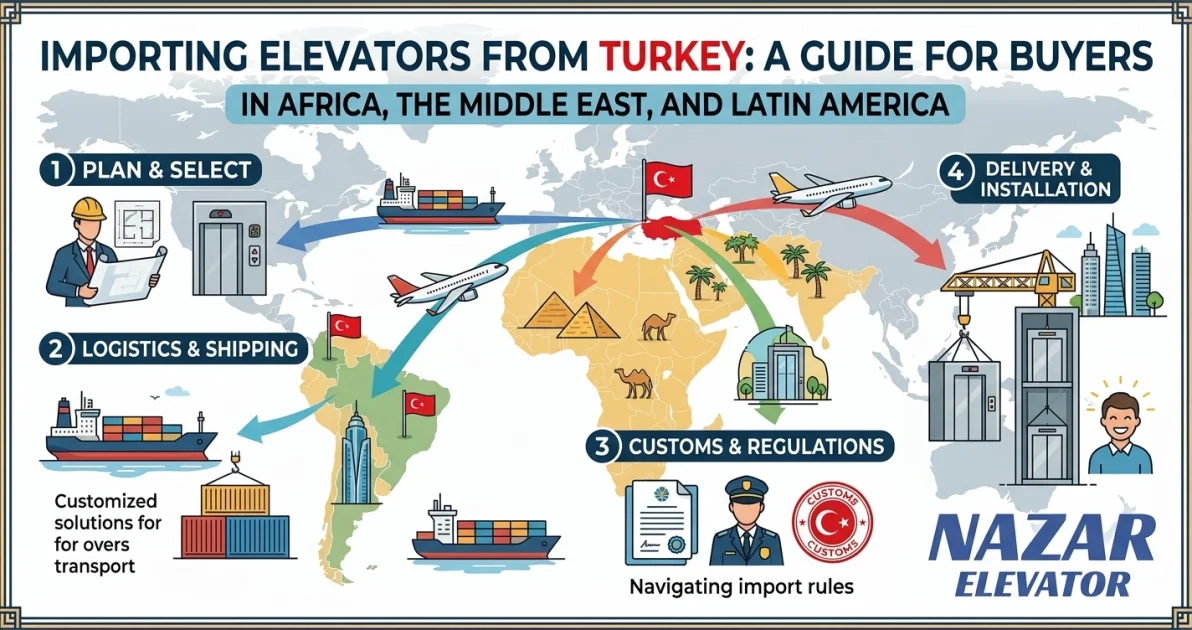
Importers in Africa, the Middle East, Central Asia and Latin America are rarely choosing between a good lift and a bad one. Both Turkish and European manufacturers place CE-marked equipment on the market under the same Directive, and both build on a largely shared European component base. The real question is different: which supply proposition fits the market you actually serve?
Below are the seven reasons buyers in these regions consistently give for sourcing from Turkey — followed by an honest account of where the argument does not hold.
1. The same compliance basis, without the Western European cost base
Lifts placed on the EU market fall under the Lifts Directive 2014/33/EU, with conformity demonstrated against the harmonised standards EN 81-20:2020 and EN 81-50:2020. Turkey participates in the EU customs union for industrial goods and has harmonised its national lift regulation with the Directive; Turkish manufacturers therefore CE-mark under the same instrument, with conformity assessment by a notified body.
For an importer whose national regulation references European standards — which describes much of the Middle East, North Africa and the Caucasus, and a growing share of sub-Saharan and Latin American markets — this means the documentation package that satisfies the local authority is the same package. What differs is the cost base behind it, not the standard in front of it.
2. Landed cost is the number that matters, and it is not the ex-works price
Buyers routinely compare ex-works quotations and are then surprised by the final figure. The comparison that decides profitability has four parts: ex-works price, freight, customs duty, and the cost of delay.
Turkish manufacturers generally quote a comparable specification — frequently with the same European traction machines, door operators and safety gear — at a lower ex-works price, driven by labour and overhead costs rather than by cheaper components. The size of that gap varies by product and configuration and should be established with like-for-like quotations that list components by manufacturer and model.
The other three parts are where the gap usually widens further, and they are covered next.
3. Trade agreements can remove the duty line entirely
Turkey has around thirty regional trade agreements covering close to seventy partners, and its agreements have offered duty-free treatment across a large majority of tariff lines. In Africa these include Tunisia, Morocco, Egypt and Mauritius; in the Middle East, Palestine, and comprehensive economic partnership agreements with the United Arab Emirates — in force since 1 September 2023 — and Qatar, with the Lebanon agreement signed but not yet in force; in South America, Chile.
Where such an agreement applies and the goods qualify under its rules of origin, the customs duty line can fall to zero. On a container of lift equipment that is not a rounding difference — it frequently exceeds the entire ex-works price gap between two suppliers.
Check this before comparing anything else. Ask your customs broker whether your country has an agreement in force with Turkey, what tariff heading lift equipment falls under, and what proof of origin the supplier must provide. The answer changes the arithmetic more than any negotiation over unit price will.
4. Transit time, and what it costs when a project is waiting
For the Middle East, North Africa, the Caucasus, Central Asia and Southeast Europe, Turkish factories ship from Mediterranean and Black Sea ports with short sea transits, and road freight is viable across a large surrounding region. Against a Far Eastern supplier the difference is measured in weeks. Against a Western European supplier it is usually modest — but the queue in front of your order is often shorter, because European majors are typically prioritising home-market and institutional work.
Delay has a price that rarely appears in a quotation: retention held, contractor standing time, a building that cannot obtain occupancy certification. On a project where the lift is on the critical path, four weeks of transit difference can outweigh a meaningful price difference.
5. Equipment specified for your operating conditions, not for Frankfurt
A lift installed in the Gulf, the Sahel or an Andean city does not face European conditions. Ambient temperatures above 40°C in unventilated machine spaces, airborne dust, high humidity, and supply voltage that sags and spikes are normal operating conditions across much of these regions — and they are the conditions that determine whether an installation is still running smoothly in year five.
Turkish manufacturers export overwhelmingly into these markets, which means the questions are familiar rather than exceptional: forced ventilation on the machine, appropriate IP ratings, controller tolerance to voltage fluctuation, 50 Hz and 60 Hz supply, 380 V and 220 V variants, and cabin materials that behave in heat and humidity. Ask any supplier to state, in writing, the ambient temperature and voltage tolerance range their equipment is warranted for. The answer separates suppliers who understand your market from those who will discover it during your warranty period.
6. A service model built around distributors, not around the manufacturer's own branches
This is the difference that decides the second decade of ownership, and it is the one most often overlooked at the tender stage.
The large European groups operate through their own service subsidiaries. Where such a subsidiary exists in your country, that is a genuine advantage. Where it does not — and across much of Africa, Central Asia and parts of Latin America it does not — the buyer is left holding equipment whose manufacturer has no local presence, with spare parts routed through a distant regional office and priced accordingly.
Turkish manufacturers built their export business on a different model: supplying and supporting local importers and installation contractors as partners rather than competing with them. In practice this means direct technical dialogue with the factory rather than through a regional sales layer, training for the importer's own technicians, documentation in the required language, and spare parts shipped to the importer rather than sold through a service monopoly.
For an importer building a maintenance business, these are not soft benefits. They determine whether the installed base becomes a recurring revenue stream or a support liability.
7. Non-standard work and modernisation at realistic volumes
Much of the demand in these regions is not standard new-build. It is a hotel with an awkward existing shaft, a hospital needing a stretcher lift at a non-catalogue depth, a panoramic car for a shopping centre, a modernisation into a 1970s structure whose shaft is out of plumb, or an order of two lifts rather than two hundred.
Large manufacturers price these as exceptions or decline them, because their economics rest on standardisation. Turkish manufacturers routinely engineer them, because their factories are structured for mixed, lower-volume production. For an importer whose pipeline is made of exactly these projects, that willingness is often the deciding factor.
Where the argument does not hold
A case worth making is worth bounding. Three situations favour European supply, and a supplier who claims otherwise is not being straight with you.
At the technical edge. High-rise buildings, rated speeds above roughly 2.5 to 4 m/s, complex destination-control groups and deep building-system integration are areas where the installed reference base sits with European and Japanese manufacturers. For a landmark tower, that experience is a legitimate reason to pay more.
Where the specification or the lender requires it. Institutionally financed projects frequently name manufacturers or require a demonstrated in-country service presence. This is a commercial constraint, not a technical judgement, but it is binding and no argument will move it.
For Latin America, the logistics argument is weak. Turkey is not closer to Bogotá, Lima or São Paulo than Western Europe is, and outside Chile there is no Turkish free trade agreement in the region to offset duty. In Latin American markets the case for Turkish supply rests on ex-works price, willingness to customise, and the distributor-centred service model — not on freight or tariffs. An importer told otherwise should discount the rest of that supplier's claims accordingly.
How to run the comparison properly
- Compare landed cost, not ex-works. Build the four-part figure: ex-works, freight to your port, duty at the applicable rate, and an explicit allowance for delay risk.
- Check the trade agreement position first. Ask your broker about an agreement in force, the tariff heading, and the proof of origin required. This single line can exceed the price difference.
- Require the component list by manufacturer and model. Traction machine, door operator, safety gear, overspeed governor, controller. A supplier who cannot answer immediately does not control their own bill of materials — and this question is answered identically by good suppliers of any origin.
- Verify the notified body number and certificate references. Self-declaration does not apply to lifts under the Directive.
- Get the environmental warranty in writing. Ambient temperature range, humidity, voltage tolerance, supply frequency.
- Establish the spare parts commitment and its duration, and ask what happens when a component manufacturer discontinues a part.
- Ask who trains your technicians, in what language, and where.
- Take three references in your own market, installed at least three years ago. Three years is long enough for early failures to appear.
Frequently asked questions
Are Turkish elevators CE certified like European ones?
Yes. Lifts exported from Turkey to the EU market are CE-marked under the Lifts Directive 2014/33/EU and assessed against EN 81-20:2020 and EN 81-50:2020 — the same instruments applied to European-manufactured lifts — with conformity assessment carried out by a notified body. Buyers should verify the notified body identification number and certificate references, which is prudent with any supplier.
Why is a Turkish elevator less expensive than a European one?
Principally because of lower labour and overhead costs, not because of cheaper components; the traction machines, door systems and safety components are frequently the same European makes. The gap varies by product and configuration and should be established with like-for-like quotations rather than assumed from a rule of thumb.
Does my country have a trade agreement with Turkey?
Turkey holds around thirty regional trade agreements with close to seventy partners. In Africa these include Tunisia, Morocco, Egypt and Mauritius; in the Middle East, Palestine, and comprehensive economic partnership agreements with the United Arab Emirates (in force since 1 September 2023) and Qatar, with the Lebanon agreement signed but not yet in force; in South America, Chile. Confirm the current position with your customs broker, since agreements enter into force, are amended and are suspended over time.
Will spare parts be available in ten years?
Where the major components are European makes, spares often come from those same component manufacturers regardless of where the lift was assembled. What varies between suppliers is whether there is a documented spare-parts commitment with a stated duration and a defined route to obtain parts. Establish it contractually rather than inferring it from the country of manufacture.
Can Turkish manufacturers supply for 60 Hz markets and high ambient temperatures?
Equipment for 60 Hz supply, 220 V variants, high ambient temperature and dust exposure is routinely specified for export markets. The verification step is to obtain the warranted ambient temperature range, humidity range, voltage tolerance and supply frequency in writing before ordering, from any supplier.
When should an importer choose a European manufacturer instead?
For high-rise or high-speed installations above roughly 2.5 to 4 m/s, for complex destination-control groups, where financing or specification names a manufacturer or requires an in-country service presence, and for buyers in Latin America the logistics and tariff advantages that apply elsewhere largely do not — leaving price, customisation and service model as the basis for comparison there.
Summary
For importers across Africa, the Middle East, Central Asia and much of Latin America, Turkish supply offers the same Directive, the same harmonised standards and frequently the same European components, at a lower cost base — with duty relief where a trade agreement applies, shorter transit for markets around Turkey, equipment specified for heat, dust and unstable supply, and a service model that supports the importer's own maintenance business rather than replacing it. It is not the right answer for landmark high-rise work, for specifications that name a manufacturer, or on freight grounds in Latin America. Everywhere else, the comparison is closer than the nameplate suggests — and it is decided by landed cost and lifecycle support, both of which can be verified before an order is placed.