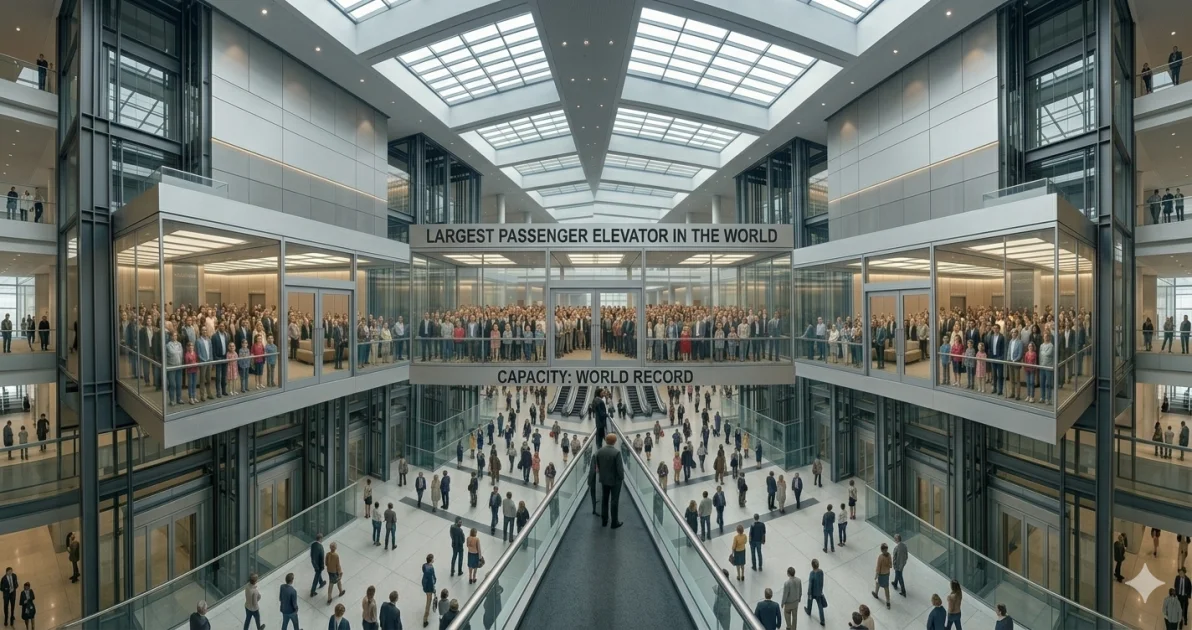
In the elevator industry, “largest” is not only a matter of size. A large passenger elevator must combine capacity, safety, ride comfort, structural strength, accessibility, door performance, traffic efficiency, and architectural integration. This is why the largest passenger elevator in the world is more than an impressive engineering record; it is a useful case study for architects, developers, consultants, and elevator professionals working on high-traffic buildings.
The elevator widely described as the largest passenger elevator in the world is located at the Jio World Centre in Mumbai, India. Designed and installed by KONE, it is reported to carry up to 235 people in a single trip, with a cabin floor area of 25.78 square metres. It serves five stops and weighs approximately 16 tonnes, making it closer in scale to a small room than to a conventional passenger lift.
What Makes This Elevator So Large?
A standard passenger elevator in a residential or commercial building usually carries a limited number of passengers, often between 6 and 21 people depending on the cabin size, rated load, and building function. The Jio World Centre elevator belongs to a completely different class. It was designed for major event flows: large conferences, exhibitions, weddings, business gatherings, and cultural events where hundreds or thousands of visitors may need to move efficiently between floors.
The most important technical point is that this elevator is not a freight elevator converted for passenger use. It is a true passenger elevator, which means the design must satisfy requirements for human comfort, safe acceleration and deceleration, door protection, emergency communication, accessibility, lighting, ventilation, ride quality, and user experience. When a cabin is large enough to carry more than 200 people, every detail becomes critical.
Key Technical Specifications
The most remarkable data point is the capacity: up to 235 passengers. This is extraordinary for a passenger elevator. The cabin area of 25.78 m² gives the lift the feeling of a room rather than a conventional enclosed cabin. KONE also states that the elevator has a unique four-panel centre-opening glass door, panoramic glass walls, two information screens, and an interior design connected to the lotus theme of the Jio World Centre.
The elevator travels between five floors at approximately 1 metre per second. For a project like this, speed is not the only priority. In high-capacity, short-travel applications, the main target is smooth and safe people flow. Door opening width, boarding time, group movement, waiting area design, and destination planning may be more important than high speed.
Another important technical feature is the hoisting arrangement. Because of the elevator’s size and weight, KONE uses an innovative pulley beam system supported by 18 pulleys and 9 ropes. The hoisting machine is the heavy-duty KONE EcoDisc MX100, and the elevator is connected to KONE E-Link, a facility management tool that allows remote monitoring.
Why People Flow Matters
The Jio World Centre is not a normal office building. It is a large business, convention, cultural, and event destination. KONE reports that the complex includes 188 KONE installations, including passenger elevators, service elevators, freight elevators, and escalators. In such a building, elevator design is not only about moving people vertically; it is about managing the full circulation strategy of the project.
People flow analysis is essential in high-traffic buildings. If elevator capacity is too low, queues become longer, visitor comfort decreases, and event operations become difficult. If the elevator is oversized without proper planning, the project may face unnecessary cost, space, and structural challenges. The largest passenger elevator in the world demonstrates that capacity must be calculated according to building use, peak traffic demand, passenger behaviour, and architectural layout.
For convention centres, shopping malls, airports, metro stations, hospitals, hotels, stadiums, and mixed-use developments, traffic analysis should be part of the early design stage. Waiting time, handling capacity, door cycle time, lobby dimensions, and passenger distribution must be studied before shaft construction begins.
Structural and Mechanical Challenges
A passenger elevator of this size creates major engineering challenges. The cabin weight, passenger load, guide rail forces, rope tension, machine capacity, braking system, buffer design, shaft structure, and fixing points must all be calculated with high precision. Even small design errors can create vibration, uneven load distribution, door alignment problems, or premature component wear.
The shaft structure is especially important. KONE states that the structural shaft moves on rails fixed over steel columns. This shows that the elevator was not treated as a standard product but as a custom-engineered mobility solution. For large passenger elevators, the shaft and supporting steel structure must be designed together with the elevator system. Civil works, mechanical design, electrical design, and architectural finishes cannot be separated.
The guide rails must resist dynamic forces during acceleration, braking, loading, and emergency operation. The suspension system must distribute the load safely and consistently. The machine must deliver enough torque while maintaining energy efficiency. The braking system must be selected for the real moving mass, not only the nominal passenger load.
Door Design and Passenger Safety
In high-capacity elevators, door performance is one of the most important factors. A very large cabin with a narrow or slow door would create bottlenecks. The four-panel centre-opening glass door used in this project helps passengers enter and exit more efficiently. It also supports the architectural purpose of the elevator by creating visibility and a premium experience.
Safety systems must be designed for crowded operation. Door sensors, light curtains, emergency alarm systems, intercoms, ventilation, lighting, overload control, emergency power operation, and evacuation procedures become more important as passenger count increases. A 235-person elevator must be safe not only during normal operation but also during power failure, emergency stop, fire alarm integration, and maintenance mode.
Accessibility is also essential. Large public elevators must support wheelchair users, elderly passengers, children, and people with reduced mobility. Control panel positioning, audible signals, visual indicators, floor announcements, handrails, and slip-resistant flooring are important details in real passenger comfort.
Energy Efficiency and Monitoring
Large elevators consume more energy than standard units, especially during peak traffic. However, modern machine technology, efficient drives, standby modes, smart monitoring, and traffic management can reduce unnecessary energy use. The use of KONE EcoDisc MX100 shows that a high-capacity elevator can still be designed with efficiency in mind. Remote monitoring through KONE E-Link also helps facility managers track performance, detect problems early, and plan maintenance before breakdowns occur.
For building owners, this is a key lesson. A large elevator is not only a mechanical product; it is a long-term operational asset. Maintenance quality, spare parts availability, technician training, and digital monitoring affect the real lifetime cost of the system.
Lessons for Modern Building Projects
The largest passenger elevator in the world proves that elevator design must begin with the building’s function. A hotel, hospital, shopping mall, metro station, convention centre, or residential tower does not need the same elevator solution. Capacity, speed, cabin size, door type, shaft dimensions, machine power, interior materials, and control strategy must all be selected according to actual traffic demand.
For most projects, installing the biggest possible elevator is not the right solution. The best solution is the elevator that matches passenger flow, safety requirements, architectural goals, and budget. In some buildings, several medium-capacity elevators may perform better than one extremely large elevator. In others, a large panoramic passenger elevator can become both a traffic solution and an architectural landmark.
Conclusion
The largest passenger elevator in the world is not impressive only because it can carry up to 235 passengers. It is impressive because it combines engineering, architecture, safety, comfort, and people flow management in a single custom-designed system. With its 25.78 m² cabin area, heavy-duty hoisting system, glass design, advanced monitoring, and event-focused traffic purpose, the Jio World Centre elevator represents the future of high-capacity vertical transportation.
For elevator professionals, the main lesson is clear: passenger elevators are not selected by capacity alone. They must be engineered around the building, the user, the traffic pattern, and the long-term operation of the facility. The world’s largest passenger elevator shows how far modern elevator technology can go when design, safety, and performance are developed together.
Focus Keyword: largest passenger elevator in the world
Secondary Keywords: biggest passenger elevator, high-capacity elevator, KONE Jio World Centre elevator, large passenger lift, elevator engineering