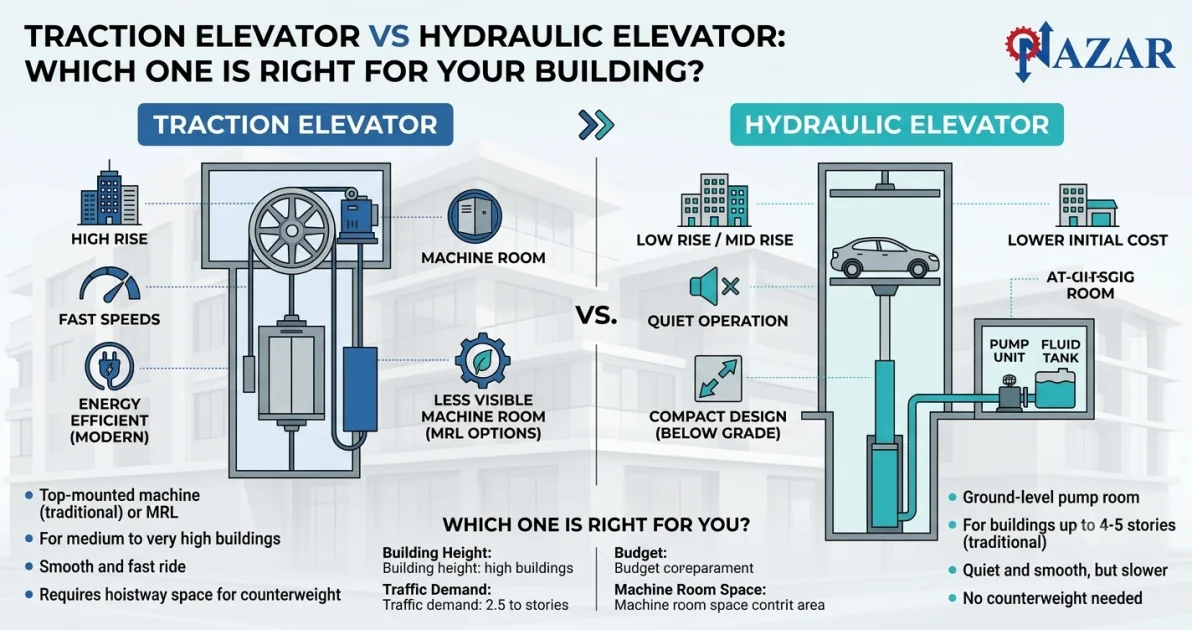
Selecting the right elevator system is one of the most important technical decisions in any building project. The choice between a traction elevator and a hydraulic elevator affects not only the initial investment, but also long-term operating costs, energy consumption, maintenance requirements, passenger comfort, and the overall performance of the building throughout its service life.
For architects, contractors, building owners, project managers, and B2B buyers, understanding the fundamental differences between these two elevator systems is essential. Each system has its own advantages, limitations, and ideal application areas. The right choice depends on building height, traffic level, shaft dimensions, speed requirements, budget, energy targets, and local regulations.
What Is a Traction Elevator?
A traction elevator operates by suspending the elevator car from steel wire ropes or, in many modern systems, coated steel belts. These ropes or belts run over a grooved drive sheave connected to an electric motor. As the motor turns the sheave, the elevator car moves up or down inside the shaft.
One of the key technical features of a traction elevator is the counterweight system. The counterweight travels in the opposite direction of the elevator car and helps balance the load. This significantly reduces the amount of energy required to move the car, especially compared to systems that lift the full load directly.
Traction elevators are available in two main configurations:
Traction systems are commonly preferred for mid-rise and high-rise buildings, commercial projects, hotels, office buildings, hospitals, public buildings, and high-traffic residential developments where speed, energy efficiency, capacity, and long-term performance are important.
What Is a Hydraulic Elevator?
A hydraulic elevator uses an electrically driven pump to pressurize hydraulic fluid. This pressurized fluid drives a piston or cylinder mechanism that raises the elevator car. When the elevator descends, the fluid is released back into the reservoir under controlled pressure, allowing the car to move downward smoothly with the help of gravity.
Hydraulic elevators are generally used in low-rise buildings, depending on the number of floors, travel height, project requirements, and local engineering regulations. They are often selected for villas, small residential buildings, low-rise commercial projects, and some freight or service lift applications.
Most hydraulic elevator systems require a machine room or a dedicated space for the hydraulic power unit, pump, motor, and oil reservoir. However, compact configurations may be available depending on the project design. Hydraulic elevators are valued for their smooth lifting performance, relatively simple mechanical structure, and practical use in low-rise applications.
Traction Elevator vs Hydraulic Elevator: Key Differences
When Should You Choose a Traction Elevator?
A traction elevator is typically the preferred solution when the building is mid-rise or high-rise, where hydraulic systems are generally not technically suitable. It is also a strong option for projects with high passenger traffic, such as commercial offices, hotels, hospitals, shopping centers, and mixed-use developments.
Traction elevators are especially suitable when energy efficiency, speed, capacity, and long-term operating performance are important. Modern traction systems equipped with VVVF drive technology can provide smooth acceleration, controlled stopping, better ride comfort, and improved energy performance.
In some configurations, regenerative drive systems can recover energy during specific operating conditions, such as braking or counterweight-assisted travel, and return it to the building’s electrical system. This can help reduce energy consumption in buildings with frequent elevator use.
Machine-roomless traction elevators are also useful when architectural space is limited. By integrating the drive machinery into the hoistway, MRL systems help eliminate the need for a separate machine room, making them attractive for modern residential and commercial buildings.
When Should You Choose a Hydraulic Elevator?
A hydraulic elevator may be the right solution when the building is low-rise and the travel height is within the operating range suitable for hydraulic systems. These elevators can be practical for private villas, small apartment buildings, low-rise commercial properties, and some service or freight lift applications.
In certain low-rise projects, hydraulic elevators may offer a lower initial investment compared to traction systems. Their mechanical structure is relatively straightforward, and they can provide smooth lifting performance when properly designed, installed, and maintained.
However, hydraulic elevator selection should always be based on a proper engineering evaluation. Important factors include pit depth, shaft dimensions, machine room or power unit space, ambient temperature, hydraulic fluid management, expected usage frequency, maintenance access, and local regulations.
Cost, Maintenance, and Energy Efficiency Considerations
Cost comparison between traction and hydraulic elevators is not always simple. The final investment depends on building type, number of stops, shaft dimensions, capacity, speed, door configuration, cabin design, control system, installation conditions, and local service availability.
Hydraulic elevators may offer a lower initial investment in certain low-rise applications. However, over the building’s service life, hydraulic pump energy consumption, oil monitoring, seal maintenance, and hydraulic component servicing can affect total operating costs.
Traction elevators, particularly those equipped with modern VVVF drive systems, are generally more energy-efficient for buildings with frequent elevator use. In high-traffic buildings, the long-term operating cost advantage of a traction system may outweigh the difference in initial investment.
Maintenance requirements for both systems depend on component quality, installation quality, usage frequency, environmental conditions, and the availability of qualified service teams. Any elevator system should be maintained by trained technicians according to the manufacturer’s recommendations and applicable local standards.
Which Elevator System Is Better for Your Project?
There is no single universal answer to the question of traction elevator vs hydraulic elevator. Both systems can deliver safe, reliable, and comfortable vertical transportation when correctly specified, properly installed, and regularly maintained.
The best solution depends on the technical and commercial requirements of the project. Building height, number of floors, expected passenger traffic, shaft and pit dimensions, available space, speed and capacity requirements, energy goals, budget, and local codes must all be evaluated before making a final decision.
For low-rise buildings with moderate traffic, a hydraulic elevator may be a practical and cost-effective option. For mid-rise, high-rise, high-traffic, or energy-sensitive projects, a traction elevator is usually the more suitable long-term solution.
Nazar Elevator Solutions for Global Projects
Nazar Elevator is a Turkish elevator manufacturer providing project-based elevator solutions for international building projects. With over 25 years of industry experience and ISO 9001 quality management principles, Nazar Elevator supports architects, contractors, project developers, and B2B partners with reliable elevator systems manufactured in Turkey.
The company’s product range includes passenger elevators, freight elevators, hospital elevators, home lifts, panoramic elevators, service lifts, elevator cabins, doors, control panels, and customized elevator solutions designed according to project requirements.
Nazar Elevator provides engineering support and project-based consultation to help customers identify the most suitable elevator system for their building. Whether your project requires a traction elevator, hydraulic elevator, machine room elevator, or machine-roomless elevator solution, the final decision should be made after a detailed technical evaluation.
Frequently Asked Questions
1. What is the main difference between traction and hydraulic elevators?
Traction elevators use an electric motor, ropes or belts, and a counterweight to move the elevator car. Hydraulic elevators use a pump and pressurized hydraulic fluid to drive a piston or cylinder. Each system has different advantages depending on building height, usage frequency, and project requirements.
2. Are traction elevators more energy efficient than hydraulic elevators?
In many applications, yes. Traction elevators, especially those equipped with VVVF drives and regenerative drive systems, are generally more energy-efficient for frequent-use and taller buildings. Hydraulic elevators usually consume energy mainly during upward travel.
3. Are hydraulic elevators suitable for high-rise buildings?
Hydraulic elevators are generally not recommended for high-rise buildings. They are typically used in low-rise applications, while traction elevators are the preferred technical solution for mid-rise and high-rise projects.
4. Which elevator system is better for residential buildings?
It depends on the building type and number of floors. For a villa or low-rise residential building, a hydraulic elevator may be suitable. For taller residential buildings with higher traffic, a traction elevator is usually more appropriate.
5. Which elevator system requires less space?
Machine-roomless traction elevators can be very space-efficient because the drive machinery is integrated into the hoistway. Hydraulic systems typically require space for a hydraulic power unit, although compact options may be available depending on the project.
6. How can I choose the right elevator system for my building?
The right system should be selected after evaluating building height, number of stops, expected traffic, shaft dimensions, pit depth, capacity, speed, budget, energy targets, and local regulations. Consulting a qualified elevator manufacturer or engineering team is strongly recommended.
Ready to Find the Right Elevator System for Your Project?
Contact Nazar Elevator to evaluate the most suitable elevator solution for your building project. Our team can support your project with technical consultation, project-based manufacturing, and reliable elevator solutions from Turkey for global markets.