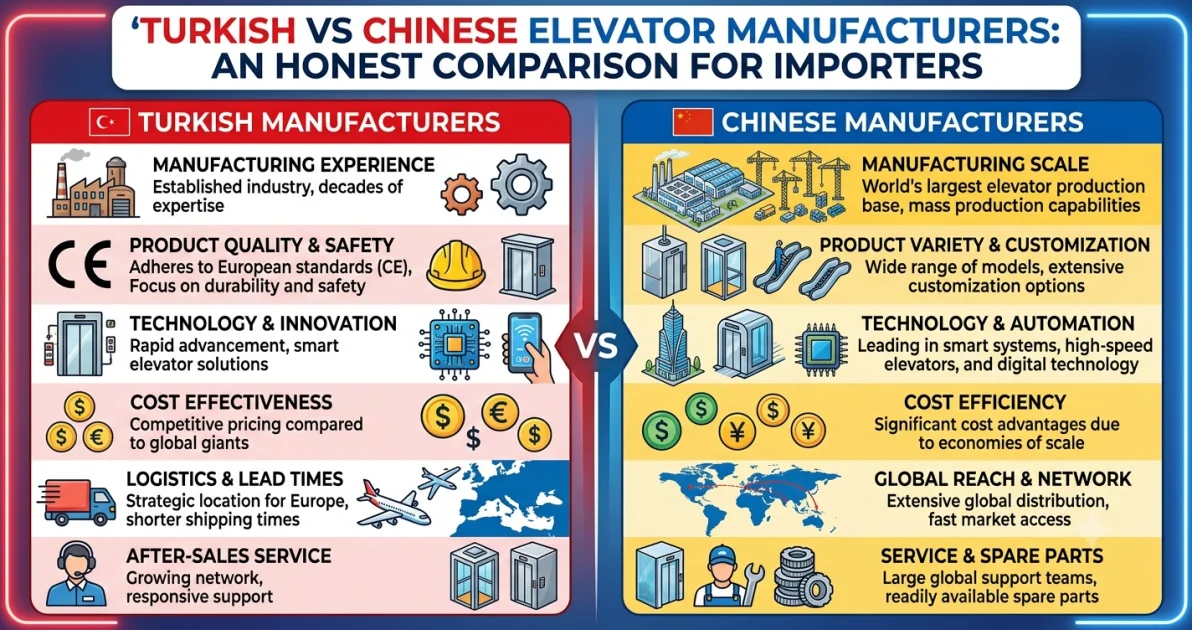
When sourcing elevators for projects across the Middle East, Africa, Central Asia or Southeast Europe, two manufacturing origins consistently dominate the shortlist: Turkey and China. Both markets have invested heavily in elevator production capacity and can supply a broad range of passenger, freight, hospital and panoramic lifts at competitive price points.
But the two propositions are meaningfully different — in compliance posture, quality consistency, logistics profile and long-term serviceability. This guide provides an honest, technical comparison to help importers make better decisions.
1. Standards and Certification
Turkish manufacturers operate within the EU regulatory framework. Turkey has harmonised its national standards with European norms, and elevator equipment exported from Turkey carries CE marking in conformity with EN 81-20 (safety rules for passenger and goods lifts) and EN 81-50 (design and testing rules). This makes Turkish-origin elevators straightforwardly acceptable in EU member states and in countries that recognise CE as a market access requirement — which now includes most of Africa, the Gulf states and much of Central Asia.
Chinese manufacturers work primarily to GB/T standards (Guobiao), the Chinese national standards. Some factories have obtained CE certification, but the depth of conformity varies significantly between suppliers. CE marking from a Chinese supplier should always be verified against notified body records, as self-declaration is common in lower-tier factories. For projects requiring EN 81-20 compliance, Turkish-origin equipment typically requires considerably less vetting.
2. Price and Total Landed Cost
This is where Chinese manufacturers hold a clear advantage at the entry level. For standard commercial or residential passenger elevators, Chinese pricing is typically 20–35% lower than Turkish-manufactured equivalents on an ex-works basis.
However, the total landed cost picture is more nuanced. Chinese systems ship from ports including Shanghai, Qingdao and Guangzhou, adding 25–40 days at sea for destinations in the Middle East or East Africa. Turkish manufacturers — particularly those based in Konya, Izmir and Istanbul — ship from Mediterranean and Aegean ports with transit times of 4–12 days to the same destinations. Shorter transit reduces financing costs, insurance exposure and the time from order to installation start.
When the comparison extends to lifetime cost — factoring in spare parts availability, maintenance intervals and the cost of downtime — the Turkish price premium often narrows considerably.
3. Quality Consistency
Quality in elevator manufacturing is not simply about the finished product; it is about consistency across a production run. A single defective safety component — a limit switch, a landing door lock, a buffer — can create liability that exceeds the purchase price of the equipment.
Turkish elevator factories typically operate under ISO 9001 quality management systems with documented production controls. Many hold EN 81-20 type examination certificates issued by European notified bodies such as TÜV, Bureau Veritas or Lloyd's Register, which mandate third-party audits of both product and process.
Chinese quality is more heterogeneous. Tier-1 Chinese manufacturers — the large publicly listed companies — maintain quality systems comparable to European standards. However, the market includes many mid-tier and lower-tier factories, and the quality gap between them is significant. Without a physical factory audit or ongoing third-party inspection programme, it is difficult to verify which tier a supplier actually belongs to.
4. Engineering Support and Customisation
Both origins offer customisation across cabin dimensions, door configurations, finish materials and control systems. The difference lies in communication and turnaround time for engineering changes.
Turkish manufacturers typically offer direct communication with engineering teams, often in English, and can turnaround technical drawings within 3–5 working days. Documentation packages — wiring diagrams, load calculations, installation manuals — are routinely provided in English, French or Arabic.
Chinese suppliers often route communication through trading companies or export agents, adding layers that slow response times. Technical documentation quality also varies; many factories provide documentation in Chinese with English summaries that are machine-translated and technically incomplete.
5. Lead Times and Supply Chain Risk
For standard specifications, Chinese manufacturers typically quote 45–70 days ex-works lead time. Turkish manufacturers quote 35–55 days for comparable products. The differential is not dramatic at the factory level.
The meaningful difference is in the total supply chain timeline. Turkish elevators can reach most destinations in the Middle East, North Africa and Europe in 5–15 days from dispatch, versus 25–45 days from China. For contractors with firm installation schedules, the shorter pipeline significantly reduces programme risk and the working capital tied up in transit inventory.
6. Spare Parts and After-Sales Support
Elevator maintenance over a 20-year lifecycle requires ongoing access to spare parts: door operator components, controller boards, encoder cables, safety gear parts and rope connections. Spare parts availability is the most underestimated factor in elevator procurement — and the one that most directly affects building owners long after the purchase decision is made.
Turkish manufacturers — particularly those with regional offices or established distributor networks — can supply spare parts to most destinations within 5–10 working days. Many Turkish factories also produce the motor units, control systems and door operators they install, meaning the full spare parts chain is domestic and vertically integrated.
Chinese spare parts availability varies by manufacturer. Well-known brands maintain parts warehouses in key markets. Lesser-known suppliers may discontinue component lines or transfer production to sub-contractors, making sourcing difficult after 3–5 years.
7. The Components Layer: A Mixed Reality
The Turkish vs Chinese debate applies not just to complete elevator systems but also to elevator traction motors, door operators, controller systems and cabin fittings. Many Turkish elevator manufacturers source specific components globally — including from European and Asian suppliers — then assemble and test complete systems in Turkey under CE-certified conditions.
This means a Turkish-origin CE-marked elevator can legitimately include high-quality globally sourced components that have individually passed type examination — providing European-standard system certification with competitive component economics.
At Nazar Elevator, we supply both complete elevator systems and individual elevator components — including motors from brands such as Torin Drive, TopGears, Ziehl-Abegg and SICOR — to contractors and distributors across more than 70 countries.
8. Regulatory Landscape by Region
Importers should map their regulatory environment before making a sourcing decision:
Which Is Right for Your Project?
Choose Turkish-origin equipment when: the destination market requires CE marking; transit time is a programme constraint; after-sales support and spare parts access are priorities; or the project involves hospitals, public buildings or high-traffic commercial installations where reliability is non-negotiable.
Chinese-origin equipment is competitive when: the project is in a market with no CE requirement and cost is the primary driver; a Tier-1 Chinese manufacturer with a verified quality track record can be identified; and the buyer has in-house capability to manage factory audits and ongoing quality control.
In many cases, the optimal strategy is to use Turkish-certified complete systems with globally sourced certified components — combining compliance and reliability with competitive component economics.
Conclusion
Turkish and Chinese elevator manufacturers both offer genuine value, and reducing the choice to "better or worse" misses the point. The right question for importers is: what combination of compliance profile, delivery timeline, lifecycle cost and after-sales support best fits this specific project?
For projects where EN 81-20 compliance, short transit times and direct technical support matter, Turkish manufacturers represent a well-established and commercially competitive choice. For cost-driven markets with lower regulatory scrutiny, Chinese-origin equipment from verified Tier-1 suppliers can make strong economic sense.
If you are sourcing elevator systems or elevator components for a current project, contact our export team for a technical and commercial proposal based on your specifications and destination market.