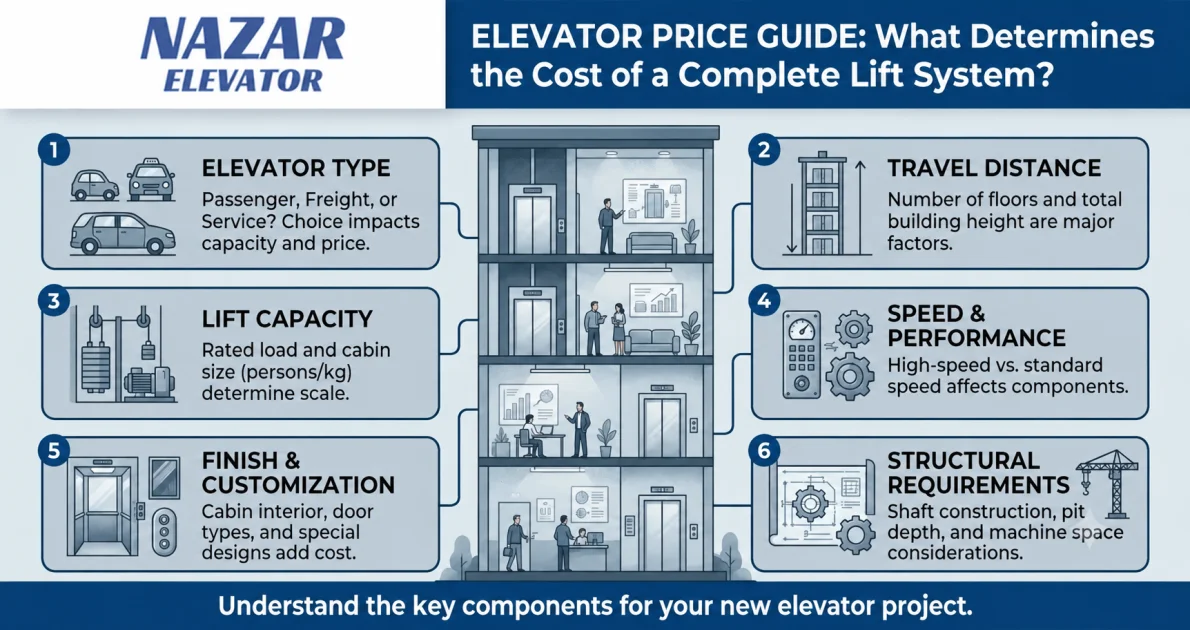
When buyers ask, “How much does an elevator cost?”, the most accurate answer is: it depends on the project. A complete lift system is not a single standard product. It is an engineered vertical transportation package designed according to the building shaft, number of stops, travel height, capacity, speed, door arrangement, safety requirements, cabin design, local standards, installation conditions and delivery terms.
For contractors, distributors, hotel developers, residential projects and commercial buildings, understanding what determines elevator price is essential before comparing quotations. A low initial price may not always mean a lower total project cost if important components, documentation, packaging, installation support or after-sales service are missing.
1. What Is Included in a Complete Lift System?
A complete elevator package normally includes much more than the cabin. Depending on the project scope, a complete lift system may include:
Before comparing elevator prices, the buyer should check whether the offer is for a complete package or only for selected components. Two offers may look similar at first glance, but one may exclude guide rails, doors, controller, safety parts, installation materials or documentation.
2. Technical Factors That Affect Elevator Price
Elevator Type
The elevator type is one of the main cost drivers. A standard passenger elevator, machine roomless elevator, hydraulic elevator, panoramic elevator, hospital elevator, freight elevator or home lift will have different component requirements. For example, a machine roomless elevator may require a compact gearless machine and specific shaft arrangement, while a hydraulic elevator uses a hydraulic power unit, cylinder and oil system.
Capacity and Car Size
Capacity directly affects the cabin size, car frame, machine power, guide rail size, safety components, ropes, buffers and structural requirements. A 450 kg residential lift and a 1600 kg hospital or freight lift cannot be priced in the same way. Higher capacity usually means heavier components, stronger mechanical structure and larger packaging volume.
Number of Stops and Travel Height
The number of stops affects landing doors, buttons, indicators, wiring, guide rail quantity and installation labor. Travel height affects guide rail length, rope length, cable length and shaft equipment. A 3-stop elevator and a 12-stop elevator may use similar cabin finishes, but their total system cost can be very different.
Speed
Speed affects machine selection, controller configuration, braking system, ride comfort and safety calculations. Common speeds such as 0.63 m/s, 1.0 m/s and 1.6 m/s are usually easier to optimize. Higher-speed elevators may require more advanced drive systems, stronger components and stricter engineering evaluation.
Shaft Dimensions, Pit and Headroom
If the shaft has standard dimensions, the elevator can usually be designed more efficiently. Low pit, low headroom or narrow shaft conditions may require special engineering, compact components, EN 81-21 type solutions or customized arrangements. These project-specific adaptations can increase cost but may be necessary in existing buildings or renovation projects.
3. Cabin, Doors and Component Selection
Cabin Design and Finishing
Cabin design has a visible impact on elevator price. Standard stainless steel or laminate cabins are usually more economical. Luxury cabins, panoramic glass cabins, decorative ceilings, special lighting, mirror panels, granite flooring, antibacterial PVC flooring, vandal-resistant interiors or custom branding can increase cost.
For hotel, villa, shopping mall and office projects, cabin design is not only a technical choice but also part of the building’s image. The right elevator cabin design should balance budget, durability, cleaning requirements and architectural style.
Door Type and Door Quantity
Automatic doors are one of the most important cost items in a complete elevator system. Center-opening doors, telescopic doors, fire-rated landing doors, glass doors, stainless steel doors and large freight doors have different price levels. The number of stops and door openings also directly affects the total price.
Controller, Machine and Safety Components
The controller, traction machine, inverter, safety gear, overspeed governor, door operator, buffers and electrical components affect performance, safety and maintenance. Choosing very low-cost components may reduce the initial price, but it can increase maintenance problems and spare part risks in the long term.
A reliable Turkish elevator manufacturer should clearly define component brands, technical specifications, warranty conditions and spare part availability in the quotation. For long-term service planning, buyers should also check the availability of elevator spare parts.
4. Standards, Documentation and Market Requirements
Standards and documentation can affect both price and delivery time. For European Union projects, lifts and lift safety components should be evaluated under Lift Directive 2014/33/EU. Depending on the project, relevant standards may include EN 81-20, EN 81-50, EN 81-21, EN 81-70, EN 81-72 and EN 81-73.
For vertical platform lift or accessibility-related home lift applications, EN 81-41 may also be relevant. For Russia and Eurasian Economic Union markets, TR CU 011/2011 and EAC requirements may need to be checked. For Saudi Arabia and Gulf projects, SASO, SABER, GSO or local consultant requirements may affect the documentation package.
Documentation such as technical drawings, electrical diagrams, manuals, packing list, certificate of origin, conformity documents and installation instructions should be clarified before order confirmation. Missing documents can delay customs clearance, installation or local approval.
5. Freight, Installation and After-Sales Costs
Elevator price should not be evaluated only as factory price. Freight, packaging, insurance, customs duties, local taxes, inland transportation, crane or unloading costs, installation labor, testing, inspection and maintenance should also be considered.
Common Incoterms in elevator export include EXW, FCA, FOB, CIF and DAP. Under EXW, the buyer usually manages most logistics from the factory. Under FOB or CIF, sea freight responsibilities are defined around the departure and destination ports. Under DAP, the seller may arrange delivery to a named destination, while import duties and taxes are usually handled by the buyer unless otherwise agreed.
As a practical planning point, a 20-foot container may carry approximately 1–2 standard passenger elevator sets, while a 40-foot or 40-foot high cube container may carry approximately 3–5 standard sets. Final container planning depends on capacity, door quantity, guide rail length, machine type, cabin size and packaging method.
Production time also affects project planning. Standard package elevators ship four weeks from order confirmation with approved drawings — not from receipt of enquiry, which is the only way a lead time can be compared between suppliers. Packages requiring custom engineering — special cabin designs, panoramic and hospital elevators, large freight lifts or non-standard shaft solutions — ship in six to seven weeks.
6. How to Compare Elevator Quotations Correctly
When comparing elevator offers, do not look only at the final price. Check the technical scope, component list, standards, warranty, packaging, delivery term, documentation, installation support and spare parts. A professional quotation should clearly state what is included and what is excluded.
7. FAQ: Elevator Price and Complete Lift System Cost
Why do elevator prices vary so much?
Elevator prices vary because every project has different shaft dimensions, capacity, speed, number of stops, door quantity, cabin design, component selection, standards, installation conditions and delivery terms.
Is the cabin the most expensive part of an elevator?
Not always. The cabin is important, but the controller, machine, doors, safety components, guide rails, installation materials and documentation also have a major impact on total cost.
Does a machine roomless elevator cost more?
A machine roomless elevator may require compact components and specific shaft engineering. In some projects it can cost more than a conventional machine room elevator, but it can save building space and improve architectural flexibility.
Can I reduce elevator cost by choosing cheaper components?
Initial cost may decrease, but very low-cost components can increase maintenance problems, downtime and spare part risks. The best solution is to balance budget, safety, reliability and long-term serviceability.
What should I send to get an accurate elevator price?
You should send shaft dimensions, pit depth, headroom, travel height, number of stops, capacity, speed, door arrangement, cabin design, power supply and target country requirements.